
Understanding the Kinetic Chain
Climbing places significant force on the fingers, wrists, elbows, and shoulders, often through a wide range of motion. Because these joints work together, pain in one area can be connected to how other parts of the upper body move and manage load.
The kinetic chain describes how body parts depend on one another to produce movement. For climbers, it helps to consider the shoulder, elbow, wrist, and fingers as parts of one upper-body system. A shoulder issue can affect how force travels through the rest of the arm, much like a waterfall carries water downstream. Looking at the whole chain can offer a broader perspective than focusing only on the spot that hurts.
Acute vs. Chronic Injuries
Acute injuries happen suddenly, often after an unexpected event such as an awkward landing or a collision. Strength and conditioning can help prepare your body, but they cannot prevent every accident.
Chronic injuries build over weeks or months, often through overuse or poor mechanics. The kinetic-chain approach is especially useful when thinking about these gradual injuries, because repeated movement and load can affect connected joints and tissues over time.
Build Shoulder Strength and Stability
The shoulder is a useful place to focus when you want to reduce compensations through the elbows, wrists, and fingers. Climbing loads the shoulders in deep, varied positions, so strength training should also use a comfortable range of motion. Loaded isometrics and slow eccentrics are two ways to build strength and control.
Loaded isometrics involve holding a position while the target muscles stay engaged.
Slow eccentrics emphasize the lengthening phase of a lift. This usually means controlling the lowering phase for three or more seconds.
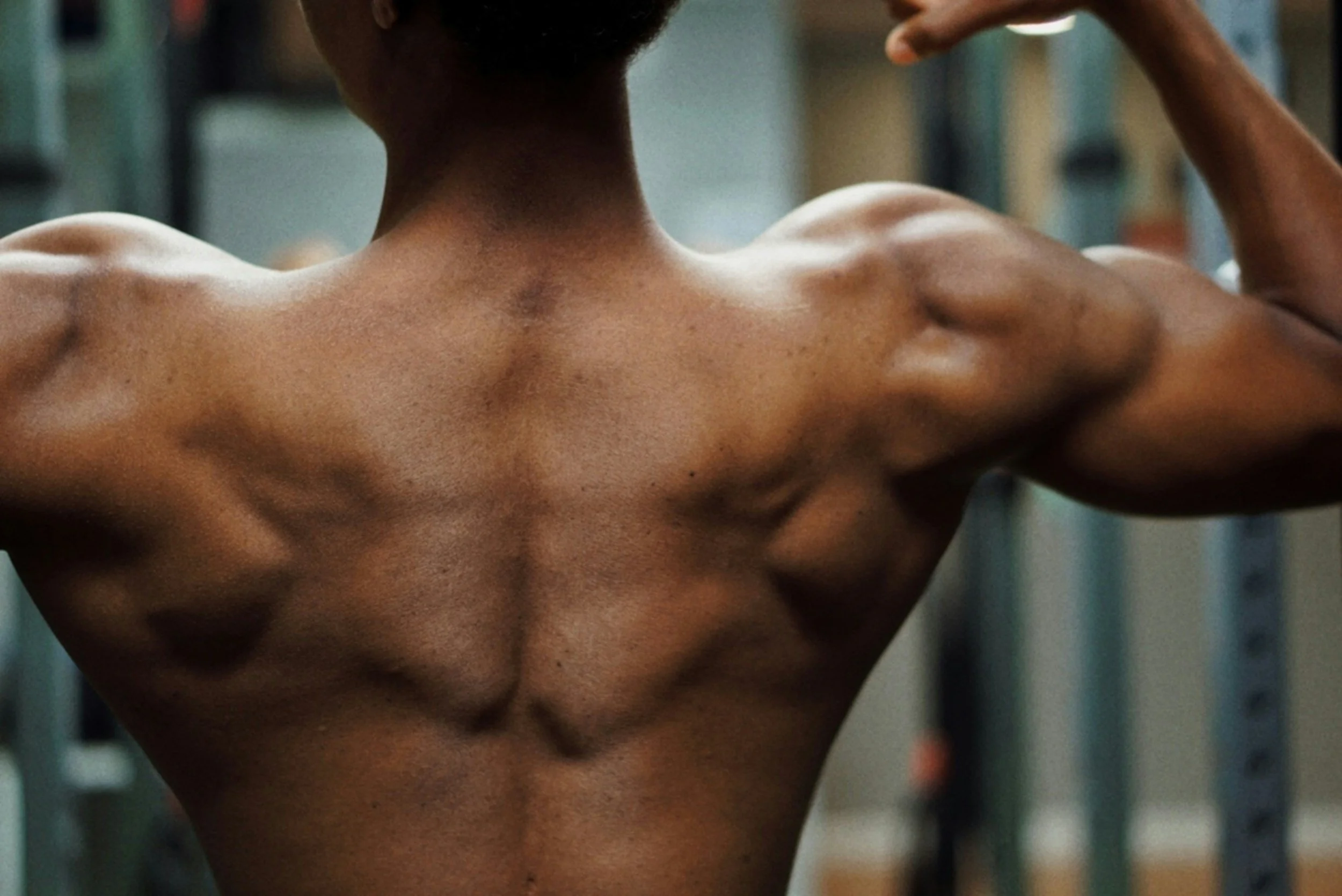
For shoulder strength, focus on the anterior, medial, and posterior deltoids, along with the trapezius and rhomboids. For stability, include the rotator cuff muscles (supraspinatus, infraspinatus, teres minor, and subscapularis) and the serratus anterior.
The seven exercises below target these muscles and are designed to help build shoulder strength and stability for climbing.
Seven Shoulder Exercises for Climbers
Kettlebell Bottoms-Up 90-90
This movement challenges shoulder stability and control of external rotation and abduction. Holding the kettlebell upside down also asks you to keep your wrist and elbow aligned while the shoulder manages the load.
Half-Kneeling Landmine Overhead Press
Overhead presses strengthen the front of the shoulder while challenging the serratus anterior and rotator cuff muscles to stabilize the joint under load.
TRX Rows with a Slow Eccentric
TRX rows load the back muscles and engage the rear deltoids and rotator cuff muscles to help control the movement. Slow the return phase to emphasize eccentric control.
Serratus Anterior Foam Roller Glides
The serratus anterior sits below the armpit and runs along the side of the ribs. It helps control shoulder-blade movement, making it an important muscle to include in shoulder-stability training.
I, T, Ys
These movements take the shoulders through a range of positions while strengthening the rear deltoids. Hold each letter for three to five seconds to add an isometric challenge. The movements may look simple, but several repetitions can make them demanding.
Prone Swimmers
Like I, T, Ys, prone swimmers move the shoulder through a range of positions and challenge the rotator cuff muscles that help stabilize it.
Push-Up Plus
This exercise targets the serratus anterior to improve shoulder-blade movement and control. The extra movement is small and happens without bending your elbows. Be patient as you practice: the goal is to develop control of the shoulder blades, which can help support shoulder mechanics.
How Often Should You Do These Exercises?
Consistency matters. Aim for two or three 10- to 20-minute sessions per week. For each exercise, start with two or three sets of eight to 12 reps. Keep your effort around 6 out of 10, with 10 representing the point when your form would fail. If the exercises begin to feel too easy, gradually increase the reps, up to 20.
If you have persistent pain or a recent injury, get guidance from a qualified clinician before starting a new exercise routine.
Strong Shoulders: The Takeaway
Your body works as an interconnected system. Although pain may show up in one specific place, it can be useful to consider how movement and load travel through the rest of the kinetic chain. In climbing, shoulder strength and control are important parts of that picture, alongside the elbows, wrists, and fingers.
Building strength in the shoulder and back muscles, along with the shoulder stabilizers, can support control through a full range of motion. Add all seven exercises, or choose a combination, to complement your climbing routine and work toward stronger, more stable shoulders. Comment below if you have questions or want to share what has worked for you.